
 About us
 Payment & Shipping
 News
 Wholesale
 Contacts
Before cross-stitching a tote bag, check the fabric: you need an even weave or a removable canvas to guide your stitches. Choose a design, mark its position and secure only the front panel of the bag. Avoid pulling the thread too tight and smooth out the fabric regularly to prevent puckering around the design and keep the back panel clear of the needle.
Cross-stitch on a tote bag: choosing the right fabric
First, decide whether you will use a bag embroidery kit or your own tote bag. For a kit, follow the instructions supplied. For your own bag, check the fabric, access to the reverse and how you will transfer the pattern.
| What you have | What to check | What to do |
|---|---|---|
| Fabric with a clearly defined, even weave | Whether you can easily count the threads and make uniform crosses | Try a few stitches on a sample of the same fabric before starting your design. |
| Dense fabric with no visible grid | Whether a removable canvas and its removal method are suitable | Baste the canvas in place over the design area and stitch through it and the outer fabric of the bag. |
| A lined tote bag | Whether you can reach the reverse of the outer fabric | Plan how you will access the stitching area before you start. If you need to unpick the lining, consider whether you can sew it back neatly afterwards. |
Removable canvases come in different types. Some are removed by pulling out the threads; others dissolve according to the instructions. Do not swap one method for another: before you start, make sure the required treatment is suitable for the tote fabric and embroidery threads.
What to prepare before the first stitch
- A pattern and threads. For your first attempt, a small design without too many scattered stitches is a practical choice: it makes counting and keeping the reverse tidy easier.
- A needle suited to the fabric. It should pass through the layers you are stitching without excessive force or visible damage. Test it on a fabric sample.
- An embroidery hoop, if you find it comfortable to use. Make sure it fits inside the bag and allows you to keep the back panel out of the way.
- Scissors and a marking tool. You can use basting stitches to mark the centre. Test any marker on an inconspicuous area first.
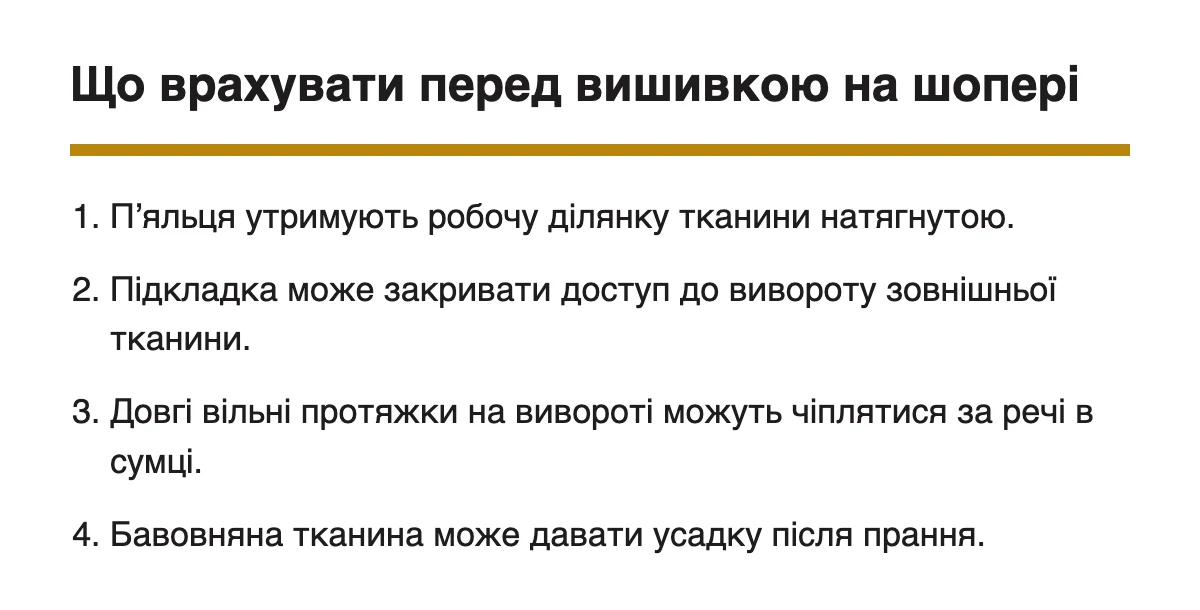
If you plan to wash the bag, check the care label. Cotton fabric can shrink, so it is a good idea to wash and dry your own tote before marking it, if the manufacturer allows this. Also test your chosen threads on a sample to check that the colours do not run.
Where to place the design
Place a paper template the size of your finished embroidery on the tote. Look at it with the bag lying flat and while holding it by the handles. Leave space around seams, handle attachments and folds: you need to be able to reach the whole stitching area with your needle and secure the thread on the reverse.

How to cross-stitch a tote bag without puckering
- Mark the centre. Align the centre of the pattern with your chosen position on the bag. If you are using a removable canvas, baste it on evenly, without skewing or creasing it.
- Move the extra layers aside. Open the bag and move the back panel and lining away from the stitching area. Check their position whenever you turn your work.
- Secure the fabric. In the hoop, the fabric should lie flat and stay in place without sagging, but it should not be stretched. If the hoop restricts access, do not force the bag into it.
- Stitch following the pattern. Keep the top stitches of all your crosses running in the same direction. Pull the thread only until the stitch lies against the fabric: no wrinkles should appear around it.
- Check the fabric outside the hoop. Release the stitching area from time to time and smooth it out. If it is puckering, loosen or redo the affected stitches before continuing.
- Secure the ends and remove the canvas. Weave the thread ends under the stitches on the reverse. Remove the canvas according to its instructions, without tugging at the finished embroidery.
Why the reverse matters so much here
Long, loose strands on the reverse can catch on items inside the tote. When moving between distant parts of the design, it is better to secure the thread and start again. Check the reverse before putting the lining back in place: there should be no loose loops or unsecured ends.
If you accidentally catch the back panel, stop and carefully unpick those stitches. Do not stretch the bag to try to separate the layers you have sewn together.
How to care for an embroidered tote bag
The care method must suit the bag fabric, threads and all embellishments. If their requirements differ, choose the gentlest permitted method. Do not rub the design itself or wring out the embroidered area; after washing, if allowed, smooth out the bag and dry it as recommended for its fabric.
Before ironing, check the permitted settings for all materials. If ironing is allowed, work from the reverse through a clean cloth, without pressing hard on the stitches. Care instructions for a decorative embroidered picture should not automatically be applied to an item used every day.
Abris Art kits
Abris Art is a Ukrainian manufacturer of craft kits. The range includes cross-stitch kits for tote bags; explore the cross-stitch kits. Compare the description of each kit with your project and check its contents before you start. If you are decorating your own bag, also browse the craft accessories and tools and choose those suited to your fabric and embroidery method.
Frequently asked questions
Can you cross-stitch on a tote bag made from dense fabric?
Yes. If the fabric makes it difficult to count threads, use a removable canvas. Check its removal method before you start: it must be suitable for the bag fabric and embroidery threads.
How can I avoid stitching through both sides of the tote bag?
Arrange the bag so that the back panel stays clear of the stitching area. With every stitch, check which layer of fabric the needle is catching; check the lining separately if there is one.
How should I wash an embroidered tote bag?
Follow the care requirements for the tote fabric, threads and embellishments. Test the threads for colourfastness on a sample before stitching. Do not automatically apply care instructions for an embroidered picture to a bag.